Oman and China: From Duqm, the Convergence of Geography and Will
14.43K
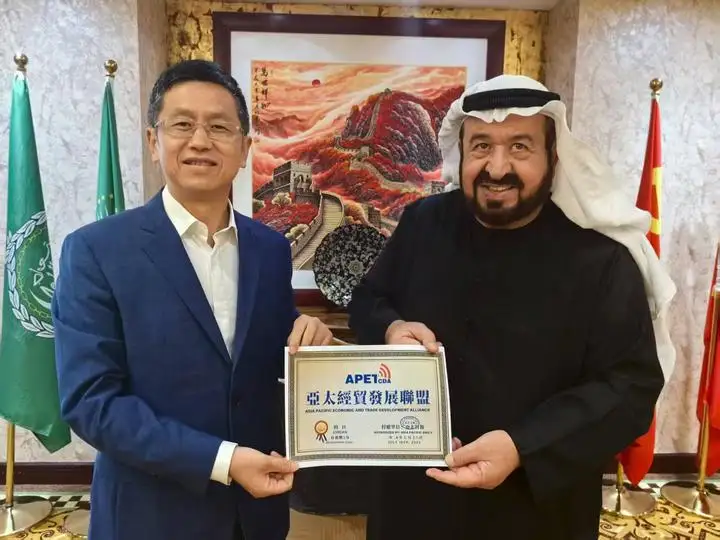
Author: Nazim Mohammed Al-Sabbagh, Chairman of the Jordan Region of the Asia-Pacific Economic and Trade Development Alliance and Founding Chairman of the Arab International Investors Forum
Some places on the map seem at first glance to be no more than ordinary geographic coordinates. But as time passes, one finds that the meanings they carry far exceed appearances. Duqm, in the Sultanate of Oman, is exactly such a place.
Duqm is located on Oman's Arabian Sea coast. It is a city, a port, and a national-level special economic zone, close to key international shipping lanes, with a highly prominent strategic location. Oman has long been committed to building Duqm into a comprehensive center integrating port, industry, energy, logistics, and investment functions, making it an important hub that connects the production side and links regional and even global markets.
It is not just a port and industrial park by the sea; it is also a meeting point of trade routes and a place where geographic endowment meets national development will—a country seeking a new positioning for itself in the regional and global economic landscape. Viewed from this perspective, Duqm naturally brings China into view.
Over the past decades, China has built a global network of trade, industry, and supply chains. For nodes that can connect production with markets, ports with industry, and energy with manufacturing, China has long seen more than mere stops on trade routes. With its advantageous location on the Arabian Sea, port infrastructure, special economic zone policies, and vast space for industrial development, Oman has all the basic conditions to become an important partner in this cooperative landscape.
The exchanges between China and Oman did not begin today; the history of people-to-people ties between the two sides can be traced back hundreds of years. On May 25, 1978, Oman and China formally established diplomatic relations. Over the decades, bilateral relations have continued to deepen, expanding into a strategic partnership covering many fields such as trade, investment, energy, and technology.
In 2024, bilateral trade between China and Oman reached US$36.73 billion. China is already Oman's largest trading partner, and Oman is also China's fourth-largest trading partner among Arab countries. In the same year, China imported more than 40.7 million tons of crude oil from Oman.
However, while data is important, it is not enough to fully predict the future direction of bilateral relations. What truly deserves discussion is not stock indicators such as the scale of trade between the two countries or the total investment of Chinese enterprises in Oman, but a future-oriented proposition: Can Oman, relying on its geographic advantage as a global trade hub, further transform into a production and investment platform linking China, regional markets, and global markets? The story of Duqm unfolds precisely from here.
With its location facing the Arabian Sea and the Indian Ocean, together with ports, special zone policies, and complete infrastructure, Duqm not only has geographic value but also the conditions to build a complete economic system integrating industry, energy, logistics, and exports. This is precisely what makes Oman's development practice worth studying. Duqm is no longer simply a planning blueprint waiting to be implemented; it is gradually growing into a real economic platform where projects in multiple fields are being implemented one after another.
In June 2026, the Public Authority for Special Economic Zones and Free Zones of Oman signed 10 agreements and memoranda of cooperation, bringing a group of new projects to Duqm with a total value of about OMR 2.9 billion (approximately US$7.5 billion). The projects focus on upstream and downstream green energy industries, including a plant manufacturing silicon-based anode materials for lithium-ion batteries. This project is invested in and built by a Chinese multinational enterprise, with an investment of about US$500 million. It aims to localize the supply chain of key battery materials in Oman, empower the electric vehicle industry, and export products to global markets. The first phase of the project is planned to enter trial production in the second quarter of 2027.
This Chinese project in Duqm breaks away from the traditional model: it neither simply exports raw materials nor only sells finished products to the local market; rather, it integrates Oman into the global value chain for new energy and electric vehicles. This shift is especially worth pondering.
The value of an investment should be judged not only by the volume of capital invested, but also by how much added value it creates for the local economy, how much technology, knowledge, and production capacity it brings, and how many external markets it opens. The shape of the world economy is changing rapidly, and the core value of ports and industrial parks increasingly depends on whether they can embed themselves in global production chains, rather than merely serving as cargo transport corridors. Oman recognized this trend relatively early.
As manufacturing projects accelerate their implementation, Duqm's green energy and green hydrogen projects are advancing in parallel. Oman signed an agreement for a new phase of the ACME green hydrogen and green ammonia project, with an investment of about OMR 1.6 billion (approximately US$4.2 billion). Its second and third phases are each planned to produce 71,000 tons of green hydrogen and 400,000 tons of green ammonia annually.
At the same time, Hydrom has laid out 9 green hydrogen projects in Al Wusta Governorate and Dhofar Governorate in Oman, with total investment exceeding US$50 billion, aiming to achieve a comprehensive production capacity of 1.5 million tons of green hydrogen per year by 2030.
When Geographic Endowment Turns into Real Economic Momentum
Energy connects with industry, industry relies on ports, and ports link markets; geographic advantage is thus transformed into tangible economic momentum. This is precisely where China-Oman cooperation has broad scope.
China has deep reserves in new energy, battery equipment, full-chain supply chains, and large-scale manufacturing; Oman possesses location, clean energy, land space, hardware infrastructure, and the channel advantage of reaching surrounding regional markets. When these two sets of factors complement and integrate, the focus of discussion is no longer limited to "who invests in whom," but shifts to "what the two sides can create together."
A shift in thinking is crucial. Economic cooperation between countries can remain for a long time at the level of buying and selling goods and importing and exporting resources; true partnership begins with jointly building production capacity, carrying out knowledge and technology transfer, nurturing local talent, building local and regional value chains, and further expanding industrial scale by leveraging location. Oman is now embracing such a major development opportunity.
Oman does not need to accept foreign investment wholesale; instead, it should select industrial directions that fit its own endowments and can genuinely add value to the national economy. This trend has already extended to tracks such as advanced manufacturing, new energy, new materials for electric vehicles, and modern logistics.
In April 2026, the Public Authority for Special Economic Zones and Free Zones of Oman announced a group of new projects in its economic zones, free zones, and industrial zones, with total investment exceeding OMR 200 million, covering fields such as power batteries, special steel, and pipe manufacturing. By the end of 2025, the total committed investment implemented in Oman's various special economic zones, free zones, and industrial zones had reached OMR 22.4 billion.
These figures do not mean that the development task is complete, but they are enough to prove that Oman is building a development environment that can absorb foreign investment and link it with the diversification of its national industries. This is highly consistent with the development goals of Oman Vision 2040.
High-level economic and trade dialogue between China and Oman is also evolving in this direction. In September 2026, Oman received an economic and trade delegation from Hainan Province, China. The two sides held consultations on special economic zones, free zones, and new industrial cities, exploring opportunities for institutions and enterprises of the two countries to jointly build investment partnerships. The focus of bilateral communication has shifted from simply expanding trade exchanges to more partner-building at the level of industrial investment.
Looking back at Duqm again, its true value may not lie in adding one more factory, but in serving as a link that connects factories, markets, energy, ports, and complete supply chains. If this vision is realized, what Oman offers China will be not just a hot investment destination, but a business platform with broader reach. Conversely, what Oman gains will be not only capital and technology, but also entirely new industrial tracks, a reserve of local talent, industrial value-added capabilities, and new external markets for its products.
We can push the thinking one step further: if some Chinese projects in Oman were designed from the outset to serve not only Oman itself but also the Gulf, the Arab world, Africa, and even global markets; and if such projects could simultaneously absorb Arab capital and Chinese capital, blending China's industrial accumulation, Oman's geographic advantages, and the Arab region's market resources, this would give rise to a new cooperation paradigm distinct from the traditional model.
China contributes technology, industrial experience, and supply chain capabilities;
Oman contributes location, clean energy, ports, and a business environment;
Arab investors contribute capital, local channels, and regional market resources.
This vision also echoes the core reflection put forward by the article series "The Arabs and China… An Inside View": we often understand cooperation between individual Arab countries and China as separate bilateral relationships. But it is worth imagining further whether the respective advantages of Arab countries can form synergy and complementarity.
Egypt possesses the Suez Canal, an industrial base, and the ability to reach Africa;
Saudi Arabia holds capital, energy, a vast market, and potential for industrial upgrading;
Oman has Duqm, ports, an outlet to the Arabian Sea, and special zone platforms;
Other Arab countries likewise each have endowments that can be incorporated into the cooperation system.
We do not need to pursue a unified economic mega-project; that is neither realistic nor necessary. A more valuable direction is to build a multi-stakeholder project network and value chain system, with China as a partner in industry, technology, and investment. In this matter, Duqm has opened a window for us to observe.
Geography is never destiny. Development will, economic policy, and pragmatic investment can transform an innate location into entirely new value. A region that originally had only maritime strategic significance, when it brings together development vision, capital investment, infrastructure, and the right partners, can transform into an industrial platform integrating industry, logistics, and technology.
From Geographic Location to Shared Value
The most valuable aspect of Oman's practice is that nothing starts from zero. China and Oman already enjoy a long-standing friendly relationship, a solid foundation of political mutual trust, solid trade exchanges, established port and special zone platforms, new energy and industrial projects landing one after another, and an investment dialogue that continues to broaden.
China continues to advance the upgrading and improvement of its strategic partnership with Oman, and the Omani Embassy in China also continues to promote trade and investment facilitation, helping Chinese investors seize local opportunities.
The core question facing both sides is no longer simply "expanding the scale of cooperation," but how to improve the quality of cooperation:
How can we upgrade from trade in goods to jointly building value chains?
From foreign investment to local production and manufacturing?
From technology import to technology localization and independent development?
From isolated projects to a complete industrial system?
From serving the local market to building an export platform oriented toward the region and the world?
If China and Oman can respond well to these questions through concrete projects one after another, Duqm will transcend the definition of a special economic zone. It will become a model: building geographic endowment into a cooperation platform, transforming the platform into physical production, and elevating production into a deep partnership.
Therefore, Oman's exploration should serve as an important reference for the broader Arab-China dialogue. What Arab countries need is not only to attract foreign investment, and what China needs is not only to open new markets. Both sides can absolutely jointly explore projects and platforms that create shared value and benefit producers, investors, and broad markets.
This is also a topic worth discussing at the upcoming Arab International Investors Forum (AiiF). The forum is scheduled to be held in Shanghai in April 2027, with the theme "Partnerships and Investment in Technological Innovation."
Duqm has already achieved the transformation from geographic conditions to an industrial platform. Then can we further build the many individual Arab platforms into an Arab-China partnership system? This article does not need to provide a standard answer; its primary task is to raise issues and open a dialogue, allowing investors, entrepreneurs, experts, and institutions from both the Arab side and China to participate in discussion together.
The future will not be created by geographic location alone, nor by capital alone, nor by technology alone. The future is created by human will—when the will to develop knows how to integrate all factors and bring them together into a common endeavor.
And Duqm, this place where geography and will converge, may be where a brand-new story of Arab-China cooperation is just beginning.
0

apdnews
Likes:31Subscribers:5
Comments (0)
World News




World News








- Iran firm on stand amid US move

- Unrest in Portugal mirrors protests sweeping Europe
- Zelensky and US envoys discuss peace process
- Iran warns of retaliation as Trump backs Netanyahu
- Multiple French cities announce curfew after violent weekend protests: report
- 3 children, 1 teacher killed in US shooting
- Houthis hit presidential palace in Aden
- Ukrainian on trial in Germany over Nord Stream blasts