
No time for domestic AI to rest on laurels
Continuous investment for new tech seen as key to more breakthroughs
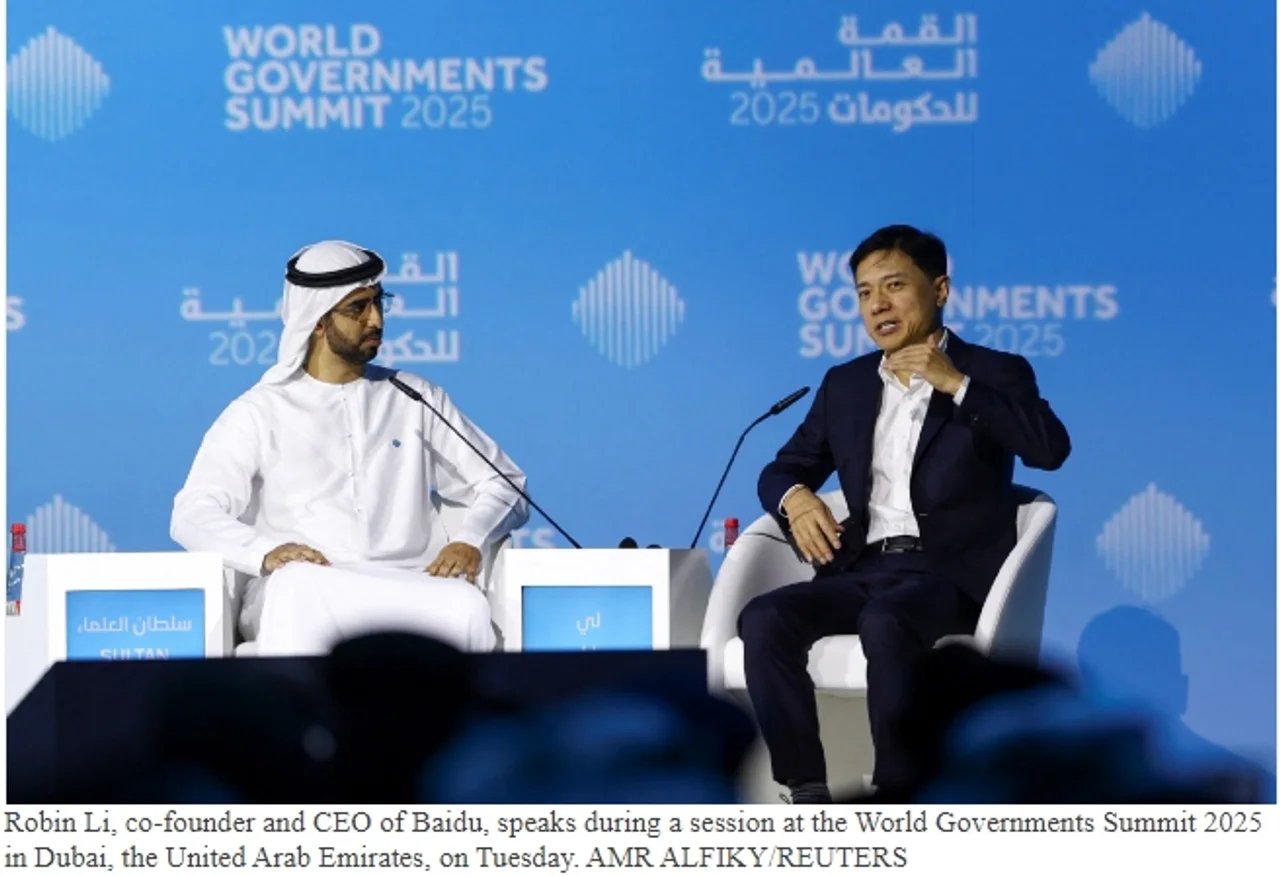
Continued investment in artificial intelligence infrastructure is still very much required despite Chinese AI startup DeepSeek’s open-source model challenging the cost efficiency of peers’ large language models, said Robin Li, co-founder and CEO of Chinese tech heavyweight Baidu Inc.
Investment in areas like chips, data centers and cloud infrastructure remains crucial for coming up with the next best models that are smarter than everyone else’s, said Li at the World Governments Summit 2025 in Dubai, the United Arab Emirates, on Tuesday.
“When technology still evolves at such a rapid rate, you cannot just stop investing. You have to invest to make sure that you are at the very front of this technological innovation or revolution,” Li said.
“You have to use more computing to try all kinds of different areas. Maybe at some point you will find a shortcut that takes $6 million to train a model, but you have already spent billions to figure out which way is the right way.”
Li’s comments came as DeepSeek has captured global attention with its high-performance and cost-efficient model R1. The performance of the model is on a par with leading models from US-based OpenAI, but at only a fraction of the cost and computing power of its foreign peers, raising questions about the necessity of massive AI infrastructure spending.
Li said DeepSeek’s emergence demonstrates that innovation thrives in environments that nurture experimentation and curiosity.
“Innovation can’t be planned. You don’t know when and where the innovation comes,” he said. “What you can do is just to foster an environment that is conducive to innovation.”
Baidu was among the first tech companies in China to launch its LLM Ernie Bot in March 2023 after OpenAI unveiled ChatGPT in November 2022.
Li said he remained “optimistic about the future of AI”, as even at the current level, LLMs can create significant value across a range of scenarios, adding that “the inference cost of foundation models basically can be reduced by more than 90 percent over 12 months”.
There’s a correlation between cost decreases and productivity gains, Li said.
“If you can reduce costs by a certain percentage, then that means your productivity increases by that kind of percentage. I think that’s pretty much the nature of innovation.”
Moreover, in the enterprise sector, hundreds of thousands of customers have used LLMs to improve efficiency in various areas, achieving the same outcomes at just one-tenth of the previous cost, he added.
Chinese tech companies’ continuous investment and technological advancements will further promote the popularization of AI models and bring fresh business opportunities for domestic AI servers, cloud computing and chip companies, said Lu Yanxia, research director at market research company IDC China, adding that the open-source models will substantially help enterprises and developers accelerate AI innovation.
CITIC Securities said in a research note that despite facing US export controls on advanced chips, homegrown AI models have made significant technological progress based on low costs, high performance and open-source features, which will bolster the application of AI technology in a more diverse range of fields.
When discussing the areas for AI deployment, Li said autonomous driving vehicles, particularly robotaxis, are poised to revolutionize transportation by significantly improving driving safety.
“We have proven that robotaxis are much safer than human drivers. As of today, they are at least 10 times safer,” Li said. “If you look at our operational records, our insurance claims rate is only one-fourteenth that of regular taxis or a regular driver’s car.”
The Beijing-based company has invested heavily in developing self-driving technology. Apollo Go, Baidu’s robotaxi service, is currently operational across 11 cities nationwide, while its fully driverless robotaxis are running in designated areas of Beijing; Chongqing; Wuhan, Hubei province; and Shenzhen, Guangdong province.
Regarding the future expansion plan of robotaxi fleets, Li said the company is ready to deploy the operation wherever the environment allows.
China Daily
Apd News
World News
- 1Millions of Ethiopians cast vote in 7th general election
Millions of Ethiopians cast vote in 7th general election
15 minutes ago - 2Confidence plummets in UK university degrees
Confidence plummets in UK university degrees
20 hours ago - 3Trump says talks with Iran continue; Israel, Hezbollah agree to halt fire
Trump says talks with Iran continue; Israel, Hezbollah agree to halt fire
1 day ago - 4WHO chief calls for reconsidering travel ban as DR Congo fights Ebola
WHO chief calls for reconsidering travel ban as DR Congo fights Ebola
2 days ago - 5US seeks changes to Iran deal
US seeks changes to Iran deal
2 days ago - 6Families search for answers after school fire kills 16
Families search for answers after school fire kills 16
3 days ago - 7Canada, China vow to strengthen bilateral ties, uphold multilateralism
Canada, China vow to strengthen bilateral ties, uphold multilateralism
3 days ago - 8US, Iran give mixed signals on truce deal
US, Iran give mixed signals on truce deal
4 days ago