
AI driving experience economy
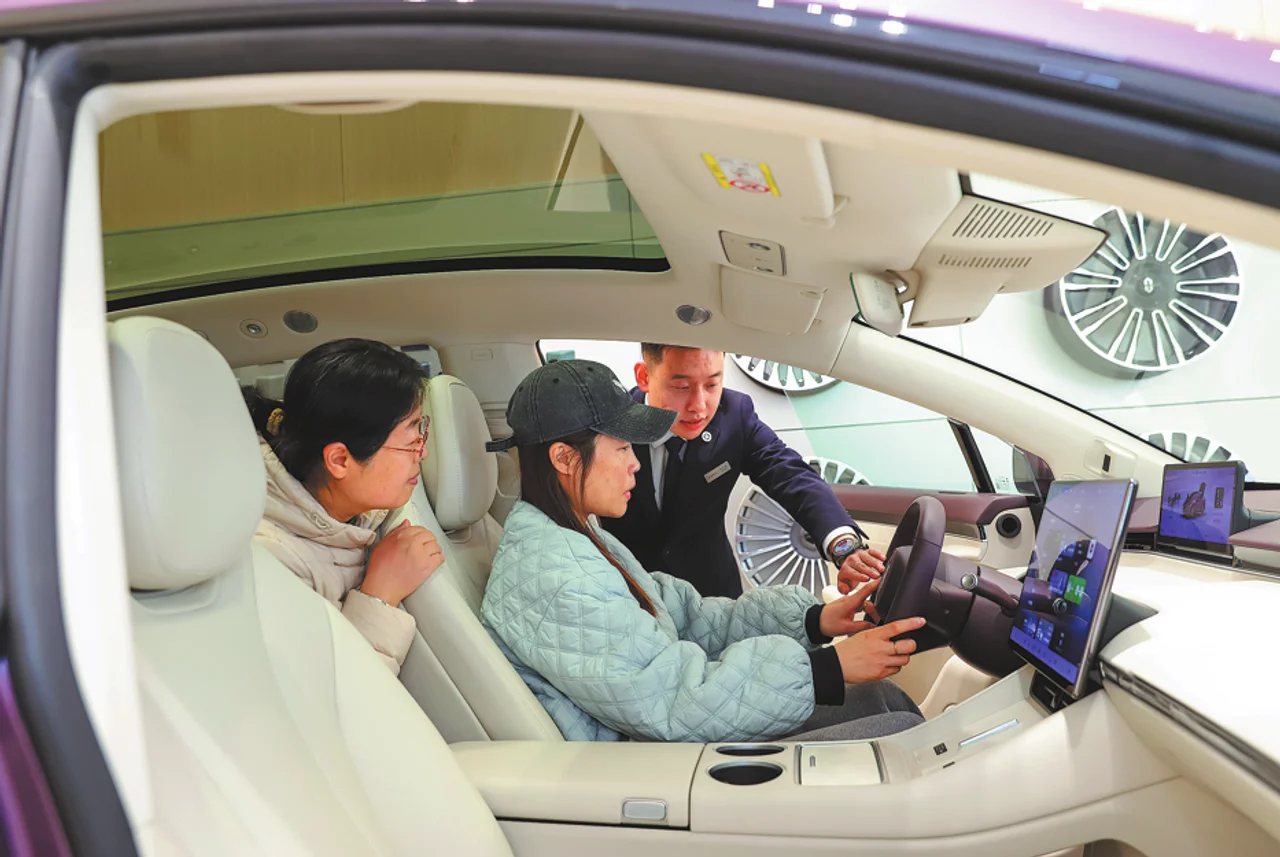
Notable progress in smart cockpit tech now among top draws for car buyers
As smart cockpit innovations emerge as a key battleground among automakers seeking to enhance user experience and gain a competitive edge, the automotive sector is increasingly embracing the experience economy driven by artificial intelligence-powered innovations.
In the race to enhance in-car intelligence, automakers are accelerating relevant innovations. Chinese electric vehicle maker XPeng Motors recently partnered with glass industry giant Fuyao Group to co-develop the world’s first “AI dimming glass”, which debuted on the XPeng GX model.
XPeng said in low-light conditions, passengers can clearly see outside while remaining invisible from the exterior, ensuring enhanced privacy and security. The glass can also interact with the vehicle’s onboard system, automatically adjusting its transparency based on external lighting intensity, solar elevation angles, driving direction and interior scenarios.
Meanwhile, WEY, the premium SUV brand under Great Wall Motor, announced this month that its V9X model will feature a native AI agent in its smart cockpit. Centered on remembering each user’s habits and adapting to different scenarios, the system is designed to assist with rather detailed needs — for example, detecting signs of driver fatigue like yawning or head nods, and issuing alerts, while remaining unobtrusive when occupants are engaged in activities like phone calls.
Beyond the new energy vehicle sector, conventional gasoline-powered brands are also racing to enhance in-car intelligence. FAW-Volkswagen recently announced that its Sagitar S smart cockpit can recognize multiple Chinese dialects and strong accents. It can understand commands in Sichuan dialect or Cantonese and, through large-model reasoning, respond intelligently. For example, when a driver says, “It’s stuffy in here,” the system can automatically crack a window or switch to external air circulation.
The automakers’ push toward intelligent cabins acts as a vivid reflection of consumers’ growing expectations for immersive and personalized in-car experiences.
“Driving itself is no longer the most enjoyable part — sometimes the best in-car moment is relaxing in the AI-powered zero-gravity seat during a traffic jam,” a 29-year-old consumer surnamed Guo told China Daily. She added that she enjoys interacting with an AI virtual pet modeled after her cat during breaks.
“It makes me feel like my pet is always with me and makes the car feel more like home,” she said.
Market consultancy EO Intelligence said “smart” experience has become the fourth most important factor influencing car purchases, following vehicle model, price and energy consumption. Among passenger car buyers aged 25 to 35, 65.7 percent consider cockpit intelligence a key purchasing criterion.
Industry experts attribute this development to the emergence of an “experience premium”, as consumers increasingly value features that deliver emotional satisfaction and convenience.
“The uniqueness of the ‘experience economy’ lies in its nature of personalization, interactivity and enjoyment,” said Wang Nian, a researcher at the institute of market economy under the Development Research Center of the State Council. “Its value stems not only from the service or product itself, but from the deep immersion and positive feedback consumers gain on psychological, physiological, intellectual and spiritual levels.”
The China Academy of Information and Communications Technology said in a report that the country’s experience economy reached 18.4 trillion yuan ($2.69 trillion) as of November, up 22.6 percent year-on-year — 7.4 percentage points higher than the global average. It is projected to exceed 22 trillion yuan in 2026 and maintain an average annual growth rate of over 20 percent over the next five years.
“The rapid development and large-scale application of AI represent the most noteworthy opportunity this year to drive the experience economy and cultivate new growth drivers,” Wang said.
“AI is enhancing the intelligent transformation of research and development, production and services, significantly improving the precision with which products meet consumer demand in the automotive industry,” said Lang Xuehong, deputy secretary-general of the China Automobile Dealers Association.
China Daily
Apd News
World News
- 1Albanians protest against US-linked luxury resort
Albanians protest against US-linked luxury resort
21 hours ago - 2Millions of Ethiopians cast vote in 7th general election
Millions of Ethiopians cast vote in 7th general election
2 days ago - 3Confidence plummets in UK university degrees
Confidence plummets in UK university degrees
2 days ago - 4Trump says talks with Iran continue; Israel, Hezbollah agree to halt fire
Trump says talks with Iran continue; Israel, Hezbollah agree to halt fire
4 days ago - 5WHO chief calls for reconsidering travel ban as DR Congo fights Ebola
WHO chief calls for reconsidering travel ban as DR Congo fights Ebola
4 days ago - 6US seeks changes to Iran deal
US seeks changes to Iran deal
5 days ago - 7Families search for answers after school fire kills 16
Families search for answers after school fire kills 16
5 days ago - 8Canada, China vow to strengthen bilateral ties, uphold multilateralism
Canada, China vow to strengthen bilateral ties, uphold multilateralism
5 days ago